Today my daughter asked me why God doesn't do miracles anymore. I told her that miracles happen every day, but they often go unnoticed.
Then she clarified, why aren't there any more miracles like those in the Bible?
I find this question profound and rather important. Think about it. There are no more burning bushes, no walls of Jericho tumbling down, no parting of the Red Sea, no water into wine. All the great miracles that were supposed to inspire faith have passed. We are left with a book and preachers. Since most Americans don't read good books, and most preachers are about as welcome as a kick to the groin, I think that we really need something.
If God were to consult an agent (and I am not really trying to give the Lord advice--I'm just tinkering, hypothetically), I think that the agent would try to arrange something big for the Big Guy. This doesn't need to be a full-blown "Comeback Tour" (I'm not ready for that one, yet; so please leave the pale horse at the stable for a while yet), but something to attract the media's attention would be awesome. How about just a "Studio Album" of sorts, or a spot on Leno, just to remind us all that He's still got it? That would be great, and I sure as Heaven would download it off of iTunes (I wouldn't dare pirate it. His wrath makes an RIAA lawsuit look like a single grain of sand in the darkest chasms of space).
This isn't a challenge. It's just a wish. While I'm wishing, I wish I could drop 80 pounds and win the lottery. Since I eat like a pig and don't buy lottery tickets, I guess I'm just left with the one. Still, that would be cool. Even cooler would be if the miracle was that I lost 80 pounds and won the lottery.
One thing that annoys me is when people answer the "Where's God?" question with that infantile, "He's everywhere. Just look around. Everything is a miracle!" That's another problem. Too many of God's spokesmen are dorks. Not everything has to be a miracle. It is not a miracle that the sun came up this morning. The Earth spins on it's axis. That accounts for the sunrise. It's not a miracle when a baby cries its first breath. It cries because it's breathing air for the first time. It's not a miracle that American Idol is a popular show. People are stupid and have poor taste.
These and other classic "examples" are awesome (meaning they have the power to fill one with awe--not "awesome" like an ollie), perhaps, but not miraculous. There's some who would say that science has stripped miracles of their meaning. That's nonsense. Science has simply, in some cases, demonstrated how some of the things that were once considered miracles are perfectly natural.
Think about the bona fide miracles recounted in the Bible. Science would have a hard time explaining how Jesus turned plain H2O into fermented grape juice. That's a change that cannot occur naturally. Scientists cannot explain how the Red Sea parted to allow for the exodus of the Jews and the demise of Pharaoh's soldiers. Science would be unable to tell us how a guy with a simple horn could knock down stone walls. Those and others recounted in the Bible are real miracles, and they simply don't happen anymore--at least not until Ben Affleck makes a movie worth watching.
Then there's those who counter with, "What about the fact that there's even a sun and an earth, or that life exists at all. Now that's a miracle."
No it's not. It's a mystery. We don't know the process of creation. You can say that you have faith, but that just means that you don't know, and you don't care to wonder.
When intelligent people ask "Where's God?" They mean, "Why doesn't God do today the kind of stuff that he did 2,000-5,000 years ago?" That's what Natalie asked, and it's a darn good question.
I'm not rejecting my faith. I'm still a half-way good (as opposed to a half-way bad) Christian. In fact, recent events (e.g. the Pope's big--but right-on--mouth) have really energized my thoughts. I'm tired of people who say that a person with faith has no reason for questions and answers. It's always, "You need to have the faith of a child." Well, this whole post started because my six-year-old asked me a question. I'm asking the same question, so it's fair game.
Oh well, I'm tired and cranky, and re-reading anything but C.S. Lewis's Mere Christianity, Miracles, The Problem of Pain, or God on the Dock (four separate and exceptional apologies--this latter word, "apology" has a classical meaning that the unlearned amongst you or maybe even you yourself have yet to grasp) will not satisfy me.
Golf Guy, do you have something for me?
Wednesday, September 20, 2006


Monday, September 18, 2006
A Hand in the Fire
Gee wiz, I guess that the Pope was wrong...
http://www.guardian.co.uk/frontpage/story/0,,1875811,00.html
From the above source:
The Mujahedeen Shura Council, an umbrella organisation of Sunni Arab extremist groups that includes al-Qaida in Iraq, issued a statement on a web forum saying the pontiff and the west were "doomed". The message, the authenticity of which could not be immediately verified, said: "We shall continue our holy war and never stop until God enables us to chop your necks and raise the fluttering banner of monotheism when God's rule is established governing all people and nations." (My emphasis)
And yet another
http://www.iht.com/articles/ap/2006/09/18/africa/ME_GEN_Muslims_Pope.php
"If the stupid pig is prancing with his blasphemies in his house . . . then let him wait for the day coming soon when the armies of the religion of right knock on the walls of Rome."
From the same article:
"Those who take benefit from Pope's comment and drive their own arrogant policies should be targeted of attack and protest."
And one more reasonable comment:
"His comments really hurt Muslims all over the world," Umar Nawawi of the radical Islamic Defenders' Front said Monday in Jakarta. "We should remind him not to say such things which can only fuel a holy war."
This latter comment is at least not violent in nature, but it assumes that violence is the answer to what Pope Benedict said ("...can only fuel a holy war.")
It doesn't have to fuel a holy war. Muslims can ignore what the Pope said, just as I can ignore what they say. Why does a fatwa have to be issued everytime a public person publicly disagrees? This doesn't seem very adab (or dare I say kosher?). Isn't it time for sensible people (including all true mujtahidun) to stand up to these fajarah and their lagwh? Surely the wise ones must know that this is not the way to taqwa.
If reason doesn't prevail, then perhaps Pope Benedict needs to read one of Urban II's famous addresses. Deus vult. Jus ad bellum est. Deo vindice.
Pax vobiscum
Sunday, September 17, 2006
Stop the Violins!
Christian Churches in Gaza and the West Bank have been shot at and firebombed, and the Vatican has been threatened specifically due to a recent speech in which the Pope indirectly (he quoted a Byzantine emperor from the 1300's) criticized Islam's policy of spreading the faith by the sword.
What a way to prove how wrong the Pope was and that Islam is innately peaceful. I surely hope that mainstream (i.e. peaceful) Muslims will speak out as critically against their impious brethren as they have against the Pope.
A high-ranking Turkish official stated that the Pope's earlier comments place him in the same category as Hitler. I don't recall any Pope in centuries advocating genocide or the physical destruction of rival faiths. On the other hand, I can think of what Al Quaida and the Taliban stood for...
Friday, September 15, 2006
Pope
The Pope must not apologize, but his critics could sure use a serving of humble pie. I just hope that the old man keeps dishing it.
Thursday, September 14, 2006
God Wants Us to Be Rich?
Check out the cover of the new Time Magazine, and read this article.
My question:
Didn't Jesus talk about laying up our treasures in Heaven and not on Earth?
If God wants us to be rich, then why did He have His Son live a life of poverty (ended by an excrutiating death)? Why did every one of the apostles (except for John), live similar lives without material comforts and die as martyrs? Why did wealth and temporal power (De Civitate Homo) not enter the picture until the Roman government embraced Christianity? Even then, monks and holy men lived humble lives.
It's trash like this that makes skeptics believe that Christians and Christianity are stupid. Why is it that the worst so often speak the loudest?
Avoid the Call!
I received a telephone call from a Republican organization. The caller started to tell me all about Governor Granholm's broken promises et al., but I stopped him short with the following (pay heed, for it might serve you well, young padawan):
"Excuse me, but I'm an anarchist who stops just short of believing that all polticians should be executed as public enemies. Needless to say, I'm not the one to whom you wish to spend your time talking."
I said it calmly, but with just a hint of possible insanity. To the caller's credit, he did conclude with, "O.K., then, as long as you're not voting for Granholm."
Tuesday, September 12, 2006
A Note and a Challenge
Golf Guy, the winner of this season's award for best comments (he received one vote because no one else voted, and he was the one who cast that vote), will be the only person to post a well argued and knowledgeable response to my Civil War essay (previous post).
This is a dare to Golf Guy and to anyone else (care to take me on again, Science Guy?).
Also, I have no idea why the font on the final paragraph of the essay differs from the preceding paragraphs. I tried to fix it, but since I don't know what caused it, I can't fix it.
This is a dare to Golf Guy and to anyone else (care to take me on again, Science Guy?).
Also, I have no idea why the font on the final paragraph of the essay differs from the preceding paragraphs. I tried to fix it, but since I don't know what caused it, I can't fix it.
Apologies & a Minor Discourse
Yes, I know that I haven't posted in awhile. It's been a long week+2.
I've been leaving for work before 7 P.M. and not returning until close to 7 P.M. This will persist until November.
Alas! but I promise to be more vigilant in my complaints, rants, and casual observations. Here's a short one for now.
A lot of people (myself included) think that George W. Bush employs tyrannical methods of governance. However, not to excuse him but to get a clear picture of things, his record proves far better than Abraham Lincoln's.
What did Lincoln do?
Among other things, he suspended the writ of habeas corpus--even though this power is reserved for Congress (Article I of the Constitution)--and tried civilians (e.g. C. Vallendingham) in military courts for such atrocities as speaking against the Lincoln administration's tyrannical policies.
He closed down newspapers who depicted him and his administration unfavorable, going so far as to arrest editors, journalists, and even vendors.
When the Roger B. Taney, the Chief Justice of the Supreme Court demanded a writ of habeas corpus for one of Lincoln's unconstitutional prisoners, Lincoln tried to arrest Taney!
After the Navy conquered New Orleans, he placed the political general Benjamin F. Butler in command of the military district. Following reports of Butler's cruelty (he executed a man who took down a U.S. flag) and corruption (you will grow weary following the money trail), Lincoln promptly did nothing.
Let's talk about underestimating your enemy's resolve. Following South Carolina's capture of Ft. Sumter (it was squarely in the state's territory), Lincoln called for 75,000 volunteers to put down the "insurrection."
Abraham Lincoln called for a reconstruction plan based upon "malice toward none." That's an easy thing to say once you have impoverished and disenfranchised all enemies who weren't slaughtered by his war machine.
Here's a little essay that I wrote a couple of years ago.
After what many deemed a “long train of abuses” by the federal government, the states of the Confederacy formed for one purpose: to establish an independent.[1] The Civil War was thus a secessionist movement, not unlike the American Revolution.[2] On the one side, Confederates fought for recognition as an independent country; and on the other side, Unionists fought to secure federal supremacy and to abolish entirely the notion of constitutional secession. The United States was to be either a loosely bound collection of sovereign states (as under the Articles of Confederation), or it was to be a single entity with a single zeitgeist, along the same pattern as the established nation-states of Europe (e.g. Great Britain) and those developing concurrently (e.g. Germany).
Secession was the main issue of the Civil War. Had there been no secession, there would have been no war. Still, individuals fought for a number of different reasons. Many on both sides simply joined because they thought that it would be an adventure, while others did not enlist at all but were conscripted. Secession (for or against) was the legal justification for both sides. The next question is why did Southerners want to secede, and why did Lincoln refuse a peaceful secession? The reasons are plenty. The war more was about economics, politics, and culture; and less about morality and idealism. These various causes coalesced into Southern secession and Northern aggression.
The Southern states seceded because they were a declining minority, and they knew it. They had for decades been well behind Northern states in the House of Representatives, and they had recently lost parity in the Senate. With the election of Abraham Lincoln as president (though Lincoln won not a single electoral vote from a southern state), only the Supreme Court remained friendly to Southern interests. However, since members of the Supreme Court were appointed by the president and approved by the Senate, Southerners knew that it was only a matter of time until they lost support from the judiciary branch as well. There was thus no separation of powers, no checks and balances, no federalism, no Constitution for Southerners; they were to be dominated politically by the North: a section that had for the past several decades been at odds with Southerners economically and politically.
That Southerners fought for the right of secession is not sufficient to explain the war; for the questions of why did Southerners wish to secede and why did Northerners wish to refuse secession remain. Of course Southerners wanted to secede because they wanted to be independent, but it wasn’t just that they fancied independence. Had they been confident that they would have been able to maintain their local customs and institutions and not have to live under a federal government lorded over by Northern interests, they would have stayed in the Union. However, they were not confident in this. In fact, they feared (and realistically so) that the political domination of the federal government by the North would mean that Southern interests would be ignored or outright bullied and assaulted; and the rise of the imperialist Republican Party meant that this usurpation was already in progress.[3]
Many historians have identified slavery as the chief cause of the war. The clearest evidence of slavery’s role in the war was its long-time status as the sectional dispute. The Republican Party was essentially born of anti-Nebraska (free-soil) factions. The Republican Party was a vast hodgepodge catering to various special-interests throughout the North, but its most basic tenet was that slavery must not expand into new territories. Knowing that such a policy was unconstitutional (see Dred Scott v. Sanford, 1857), Southerners cringed at the notion of Republican control of the White House. Of all the slave states, only four remained in the Union after that fateful Spring of 1861. Of the four "loyal" slave states, only Delaware was not rife with Confederate sympathy—for only a nominal slave-based society existed in that state. When Lincoln's armies were losing on the field, he issued the Emancipation Proclamation. The ratification, in 1865, of the Thirteenth Amendment ultimately ended the debate.[4]
So slavery was certainly an essential division and helped to facilitate hostilities, but what about slavery was so divisive? First, the Civil War was not a moral crusade waged by abolitionists in the North to redeem the nation of its sin. Slavery was an economic and political issue, and because of its obvious immorality has always been the most visible political, socio-economic difference between the antebellum North and South. Behind the issue of slavery are a number of specific economic issues ranging from the contest between an industrializing, free-labor based North and an agriculturally based South with more than four million slaves employed in the various tasks of cash-crop agriculture; however, most Southerners who fought and died in the war were not slave owners, and most Northerners who fought and died in the war were not abolitionists.[5] Yes, there were radical abolitionists in the North and radical pro-slavery men in the South, but overwhelmingly few men in either section possessed moral inclinations for or against slavery that were so strong as to inspire them to die for their causes. Furthermore, while there were many Southerners who had invested a great deal of capital in slaves (and who thus possessed a vital economic interest in its preservation and expansion), most Southerners were yeomen who owned few if any slaves. Minor slave owners would have been severely inconvenienced by abolition (which was not even Lincoln's or the majority of Northerners’ goal), but they would not have been fiscally destroyed by it. For the many yeomen who owned no slaves at all, the economic threat posed by the anti-slavery North was miniscule.[6] Slavery as an economic issue merely is simply not an adequate conclusion. Most Southerners opposed anti-slavery sentiments and policy, but not on economic grounds; and most Northerners disliked the idea of slavery, but not because they were civil rights crusaders.
The problem with identifying economic divisions as the cause of the Civil War is that the economic divisions were political in nature. Economics means the study or organization of production, distribution, and consumption. Yes, a slave society is economically different from a free-labor society, yet the problem with slavery was not an economic one.[7] Southerners were not worried that slavery would become economically unfeasible by itself; they feared that Republicans would use the coercive power of government to eliminate slavery in the territories first, and slavery in the slave states second. Free territories become free states, and free states have Northern interests and elect Northern-minded representatives and senators. This means that slavery and anti-slavery were decisively political issues.
The persistent noise made by radicals such as William Lloyd Garrison and the bold action of John Brown at Harpers Ferry (though neither man was particularly popular, even in the North) made the threat of Northern aggression against slavery seem all the more immediate. Although moralists in the North were a well-organized force, they were in no way representative of the bulk of Northern society. While many a Southerner would have enjoyed lynching William Lloyd Garrison, the most immediate threat to Garrison’s life came from a mob in Boston. Generally, abolitionists were not politically powerful (Seward’s abolitionism was a chief reason why Republicans nominated Lincoln, the free-soiler, and not him); however abolitionists’ incessant preaching provoked fear and indignation amongst Southerners.
Many Northerners were indifferent to slavery when it came to moral issues, for Northerners were every bit as racist as Southerners. In fact, the American Colonization Society was established not to free slaves but to ship freedmen back to Africa or to some undetermined Central-American colony.[8] Many Northerners did not want to abolish slavery because they were afraid that freedmen would move north, take their jobs, and mingle with their wives and daughters.[9] On the other hand, most Northerners resented the dual advantage of slaveholders: (1) The ability to farm at low-cost and (2) due to the 3/5 Compromise of the Constitution, slaves were counted for Southern representation in the House of Representatives. The Republican Party sought support from many Northerners by promising them essentially free “homesteads” in the western territories. Those who received homesteads were likely to be poor or modest Americans who could not afford land otherwise. Since these people were economically modest (at best), they would not be able to afford slaves, so free-soil went along with homesteading (free-free-soil). Northerners—the only supporters of the Republican Party—who sought to seek opportunity out west did not want to compete with Southerners’ slave labor, and they did not want to live near African-Americans. Most Northerners who really thought about it, wanted the territories to be white. That means no slavery. That means free-soil, and that means that Southern interests were at odds with Northern interests.
The “economic” issue of slavery was thus largely a political and social one, and what Southerners heard from their Northern brethren was hardly the sound of fraternal goodwill. Although few in overall numbers, the abolitionists were insatiable in their moralizing that Southerners—via the institution of slavery—were evil, corrupt, backwards, and essentially violent people (Preston Brooks did nothing to help this); and although still a minority movement, abolitionist sympathy was visibly growing in many parts of the North, especially since Harriet Beecher Stowe’s publication of Uncle Tom’s Cabin. This forced Southerners always on the moral defensive. Abolitionist groups could nearly logjam Congressional sessions with anti-slavery petitions, and when Southerners protested they were derided for opposing free speech. Anti-slavery politicians (whether for economic or racist reasons) were seeking to bar slavery from expanding into territories. John Brown slaughtered pro-slavery settlers in Kansas. New Englanders were flaunting their disregard for the Fugitive-Slave Act—a central part to the compromise that had allowed for California’s admission as a free state—with personal liberty laws. Writing for The Liberator, William Lloyd Garrison damned Southerners to Hell. John Brown killed men and seize the federal armory in Harpers Ferry and attempted to distribute weapons to slaves who would then massacre white Virginians, only for Henry David Thoreau to eulogize him as the only true man and epitome of a hero in America. To top it off, Abraham Lincoln, who was so unpopular in the South that he failed even to gather enough support to be on the ballot in some states, seized the Presidency without gaining a single electoral vote south of the Mason-Dixon line. And what did Abraham Lincoln support? He was a staunch Republican: free-soil, protective tariffs, internal improvements, and central banking. He was the first president whose entire platform was essentially hostile to Southern interests.
Slavery aside, the institution of a high (some might say prohibitive) protective tariff was another polarizing issue. Protective tariffs deal with economics, for they seek to alter the distribution and consumption of certain goods; however, like slavery, tariffs are really political policies. It’s one thing to say “Buy American,” and its another thing to use the coercive powers of the state to inflate artificially the price of imports. Furthermore, protective tariffs clearly favored Northerners at the expense of Southerners. Southerners grieved, for while the Constitution empowers Congress to enact tariffs as a means of generating revenue for the federal government, it does not grant Congress the right to use its legislative powers to influence the economic choices of free citizens and funnel money from one section to another.
To Southerners, who manufactured little, protective tariffs were a Northern scheme, promoted by special interests, to rob Southerners of their money. Many Northerners claimed that protective tariffs fostered industry in America, which was good for the country as a whole. As they continued to mature, the American textile industry would thus consume more Southern cotton, but this argument did not sway Southerners. First, whether the British or New Englanders purchased cotton did not really matter. It was still being purchased. Second, a protective tariff rang eerily similar to the mercantilist policies (Navigation Acts, Hat Act, Iron Act, Sugar Act, Townshend Acts, Tea Act, etc.) of the British, who had argued that what was good for the motherland was good for the colonies. Just as the citizens of Massachusetts had denied the right of Parliament to tax them in order to rescue the British East India Company, the citizens of Charleston et cetera refused the right for Washington, D.C., to tax them in order to benefit textile mills in Massachusetts. Southerners were farmers, the most influential of which were cotton planters. Due to the South's unique geographical disposition, cotton plantations were in no need of “protection.” New Englanders could not produce cotton in New England, nor could the British or French grow cotton in Wales or Burgundy. Since no money was taken from Northern interests to help Southern interests (no such money was needed), Southerners, by opposing protective tariffs, simply invoked the golden rule.
Federal funding of internal improvements was a political-economic issue similar in nature to tariffs. For decades, Whigs led by Henry Clay (and later Republicans led by the likes of Lincoln—who had started out as a Whig die-hard) had tried to secure support from powerful, special interests in the North by lobbying for federal subsidies of certain projects, namely canals and railroads. For which section of the country did most of these projects apply? Not surprisingly, the bulk of internal improvement designs were for the North. This would mean that federal tax dollars, much of which was taken from Southerners, would be spent “improving” the North. For the same reasons that Southerners opposed tariffs, they opposed these internal improvements. It’s not that Southerners disliked canals and railroads, but they resented the notion that money from Mississippi, Georgia, et alia should be used to build canals in Illinois (a favorite plan of Abraham Lincoln’s).[10] As largely independent yeomen, Southerners were not generally helped by tariffs or internal improvements, so they resented having their coffers looted anytime a Northern special interest cried foul over international competition or developed a grandiose scheme to dig a canal across Michigan.[11] If Michiganders, New Yorkers, or the citizens of any northern state wanted a canal, railroad, or such, then let Michigan, New York, or whomever foot the bill.
Like tariffs and internal improvements, a central bank was clearly a Northern favorite and stood well against the interests of most Southerners. This debate had deep roots in American sectionalism. The first national bank was the brainchild of Alexander Hamilton, a centralizer who saw the bank as an opportunity to plant the national government firmly in the economic life of the United States.[12] Thomas Jefferson had opposed the national bank for exactly the reason that Hamilton had supported it. After Hamilton’s Federalist Party declined into nothingness, Henry Clay’s Whig Party picked up its pieces, a chief one of which was the national bank. When the Whig Party died, Republicans carried on the tradition.
Republicans wanted to influence the value of currency and manage credit via a central bank. Southerners recoiled in distaste. A national bank was yet another weasel-concept, designed by Northerners to enrich themselves at Southerners’ expense. Southerners still held Andrew Jackson’s fear that such control over the nation’s money supply would only foster corruption in the government and disaster in the market. A national bank would hold a tyrannical power over credit, doling money out to its favorites (Northern industrialists and speculators). A national bank also would wreck the economy by weakening the currency through paper money schemes. This is why Jackson and fellow Southerners had long promoted states as the best arbiter in banking and specie—not paper notes—as the only secure form of currency. When state banks gave reckless amounts of credit to speculators and printed their own notes to use as currency, Jackson ordered that all federal land transactions be made in specie. This was as far as Jackson believed the national government could go into banking, for the Constitution provided no basis for which to establish a national bank. Paper money was a bad idea too, for it is inflationary and hard to resist printing more and more. Paper money schemers are special-interest inclined, supported by those who wish to have instant money but do not have enough on hand or sufficient capital to acquire it. The fact the Confederacy would go on to commit most egregious paper money schemes shows not their rejection of sound monetary policy but their fiscally desperate condition.
Too often historians overlook tradition as a fundamental cause of secession. After all, the American Revolution was, at its heart, a secessionist movement.[13] The American colonies seceded from Great Britain because they were tired of being exploited by the English in Parliament; so too did Southern states secede when they were sick of being looted by Northern special interests. Of course for American colonists the issue was one of not having representation (a political issue), which Southerners undeniably had. However, if the Americans had had representation in Parliament, they would have been a minority so small that it would have been impotent in promoting the colonies’ interests. Such was exactly the case of the Southerners. Government is supposed to be based upon the consent of the governed, but consent suggests majority support. In light of its minority status in the House and the Senate, Southerners could refuse consent to any number of things but still been unable to stop them. Although Hamilton #9 and Madison #10 of The Federalist Papers argued eloquently that no faction in a country as large as the United States could ever grow strong enough to oppress minority rights, neither man could have realized how sectional the United States would become. The Republican Party was completely sectional, and it had just seized control of the White House. Appreciating the tradition of secession that ran deep in American heritage and recognizing the error of Federalist #9 and #10, Southerners could rationally latch on to secession as their last, great hope.[14]
As an agriculturally based society, Southerners were prone to a very distinct political philosophy. Farmers—even subsistence farmers—tend to be of a very independent-minded ilk; and while most Northerners still farmed the land, the North was more and more being characterized by its bustling metropolises and commercial-industrial economy. To a Southern farmer, the government was an idea, not an actual force, with the mission to protect life, liberty, and property; and owing its existence to popular consent. Understandably, a man's rights in a rural setting are minimal; so Southerners had very little need for any government at all, let alone a Northern controlled federal government. The only government active in the states should be the states’ own governments, and state governments’ activity should be relegated only to measures that protected the lives, liberty, and property of their citizens. Southerners believed in strong state governments, but strong is not used to modify “state governments”; rather, it is used to contrast states with federal power. A Mississippi Delta planter expected noninterference in his affairs, but, if there must be interference from a government, it ought to come from Jackson, not D.C.
The American colonial experience had demonstrated how oppressive an “active” government could be. As traditional republicans (irony not intended), Southerners wanted a latent, not an active government. Southerners were opposed the ambitions of both forms of political activists: special-interest groups (e.g. canal diggers and railroaders who sought subsidies for “internal improvements”) and the idea of an “active” government empowered to use its force to direct socio-economic policy (e.g. protective tariffs and free-soil). Northerners, especially New Englanders with their underlying streak of Puritanism, tended to see the government as an instrument of social change and economic influence. Besides, Northerners were in the majority, and a majority unchecked will always use its power to exploit minorities.[15]
Seen in this light, the economic conflicts between Northerners and Southerners were so thoroughly mingled with political issues that they were essentially political in nature. The question of slavery in the territories was really a question about individual property rights, states’ rights, and federal incursion into these matters. If, as the Dred Scott decision stated, slaves were property and, like other forms of chattel (e.g. mules) could be brought from one place to another with no change in their status, then the federal government possessed no right whatsoever to meddle with it in the territories. Southerners thus believed that the territories should be open to all Americans and that the federal government could not justly discriminate against legal property. On the contrary, the function of the executive branch is to protect a man’s property. If tariffs and internal improvements do not “promote the general welfare,” but benefit only the welfare of a special interest, then protective tariffs and internal improvements are unconstitutional.[16] Furthermore, internal improvements are state issues, not national issues. Federal funding of them is thus an usurpation of state prerogatives.
Most white Southerners owned their own land, so they resented the Republicans’ desire to elicit support by offering (virtually free of charge) large tracts of land—land in territories in which Republicans hoped to refuse Southern interests with their catchy slogan: “Free soil, free speech, free labor, free men.”[17] Southerners had the right to ask, “Whose government is this?”
In his Gettysburg Address, Lincoln supports “a government of the people, by the people, and for the people,” but Southerners knew which people he meant, and it was not they. When they seceded, they thought that they were establishing a government of their people, by their people, and for their people. Unfortunately for them, Lincoln, the Republicans, and most other Northerners refused to recognize the right to secession. Fearing that secession would lead to a decline in stature for the United States (it certainly would have weakened the power of the federal government if the states possessed such a massive check to its ambitions) and wanting to lead the only empire of the Western Hemisphere (and avoid losing consumers of its goods to the British), Northerners waged war.[18]
In every political-economic issue, Southerners, for the most part, sided against the federal government; while Northerners, for the most part, tended to support the expanding powers of the federal government (which they controlled). It was the old argument between Alexander Hamilton, the New Yorker, and Thomas Jefferson, the Virginian.[19] And just as Hamilton took the field at Weehawken to maintain his exalted station, Northerners and Southerners alike took to other fields: Manassas, Shiloh, Antietam, Gettysburg, etc.
So the economic issues behind the war were really political issues. Then again, these economic issues tangled in political issues were also rife with cultural entanglements. Of course there were a myriad of cultural similarities between Northerners and Southerners: language, religion, and a common history; but these alone did not suffice to suppress sectional divisions. In a way, sectionalism is about culture. The word culture is rooted in the word cult, and a cult is a group of people loosely or strictly connected by similar beliefs. All religions are cults. The scientific community is a cult—or many different cults depending upon the issue (e.g. quantum mechanics versus Einstein’s theory of relativity). Political parties are cults, as are Marxist and Austrian economists.[20] In short, different “cultures” can exists amongst and within very similar groups of people, and the differences between them can often be surprisingly minor (e.g. moderate Republicans and conservative Republicans)—but these differences seem minor only to those outside of the disputing cultures’ spheres of influence.[21]
Culturally, the South had not changed much since the Revolution. When the United States achieved its independence, both the North and the South were overwhelmingly rural. Even the North’s “big cities” (e.g. Philadelphia, New York, Boston) were relatively small. By the time of the Civil War, the South was still overwhelmingly rural, but the North was changing into an urban-industrial giant. When the United States achieved independence, every one of the 13 new states was a slave state. By the time of the Civil War, slavery remained only in the South. The 19th Century saw the North’s population skyrocket through combinations of natural reproduction and massive immigration, the population of the South—while it increased—fell well behind the North and was increased by no significant waves of immigration.. Everything, it seemed, was changing in the North. Nothing much since the invention of the cotton gin had changed in the South, and the cotton gin had really only entrenched agriculture in the South. In many respects, Southerners were simply recalling their heritage. As changes in British policy and imperial arrogance had alienated American colonists from the motherland, changes in the North and Northern political and socio-economic designs for the United States had alienated Southerners.
So at first it seems like a contest over the economic policies of the federal government; then it seems that the contest is really over the political power of the federal government to support economic policies; only for it to become clear that the economic and political quarrels are both rooted in a cultural conflict. However, to say that the war was over this or that is to exclude far too much. Economics played a role in the conflict. Northern economic interests certainly played a role in their hostility to Southerners, while Southern economic interests led them to resent Northerners. What made the economic issues worse was that Northerners sought to use federal power in achieving their goals, and Southerners, who were in the minority, could not stop Northerners from doing so. Behind all of this was a generally static culture in the South resisting a generally dynamic culture in the North.
The bottom line is that Southerners did not believe that their culture was safe in the Union, so they left the Union. The conflict comes down to a changing, ambitious North and a reactionary, anxious South. To Southerners, the Republicans planned to turn the government into a fearsome leviathan, and secession was their only method of resistance. Since Republicans were essentially “empire builders” whose imperialistic and sectional plans would deteriorate upon secession, they made war upon the South. Northern democrats joined in because patriotic sirens and Southern hostility hypnotized agitated them. Southerners who stood to gain no tangible political, economic, or social advantage in the war were also nonetheless lured by patriotism to the South and a general hatred for the North. Apolitical men on both sides—and there were many men who fought for no real objective at all—took up arms because they wanted to participate in what was surely the great event of the century or because they were conscripted into service. There is no practical way to generalize the causes of the war.
One great question remains. Were the fears that led Southerners to secede reasonable? One need look no farther than Reconstruction to see that, once sufficiently empowered, the North would dominate the South and its economic, social, and political institutions. Many historians talk about Reconstruction as something of a revolution, but they tend to miss something important.[22] Southerners did not experience Reconstruction as a revolution within the South of Southerners who sought to change their culture, and what the North did was not so much revolution as exploitation.
What did Reconstruction mean to Southerners? It meant a loss of political rights, an invasion of Northern carpetbaggers seeking to exploit the Southern economy (which had been wrecked by Northern armies), and the abolition of slavery. To regain “official” statehood, Southerners had to consent to virtual extortion by ratifying Northern constitutional amendments. Known Confederate sympathizers and abettors were prohibited from voting, while freedmen were given the right to vote because propertyless, illiterate freedmen would elect Republicans (their liberators) who meted out nothing but empty promises (how many freedmen were given 40 acres and a mule?). The few Southern whites who did vote Republican were branded as scalawags, ostracized, and often terrorized by their angry, betrayed peers.
For Southerners, Reconstruction meant having to live in a country with a protective tariff, federally funded internal improvements, and a federalized bank system. All their nightmares had become true, and all that they had fought to ward off was forced upon them. Reconstruction shows clearly that Lincoln and his party fought to cement a federal presence in the South, to abolish all that it detested (for whatever reason), and augment all that it desired. And what of the moral and idealistic aspects of the Northern war effort? Reconstruction saw the end of slavery (the Thirteenth Amendment), but the end of slavery simply meant a new form of suffering for freedmen. Now they were free to starve and die. The great moralists who had talked so much of elevating the black man’s station did pitifully little to help the freedman come “up from slavery.”[23] The Freedmen’s Bureau and other "charity" organizations often served for little more as fronts to corrupt, exploitive designs.[24]
Reconstruction failed to bring about an economic revolution in the South. The South remained cotton land. The only difference was that tenant farms replaced plantations; slaves became sharecroppers. Industry did not take root in the South. Free labor was perverted into peonage, and blacks remained at the bottom of the socio-economic strata. Since they were no longer a master's property, individual blacks lost all "value" to whites except inasmuch as they could be exploited.
Reconstruction also failed to secure democracy in the South, for it temporarily eliminated most of the white franchise. The North did enact the Fifteenth Amendment to secure the right to vote for blacks—to a certain extent. Where they were practically guaranteed to vote Republican (the South), blacks were enfranchised; where the Republicans did not need a new voting bloc (the North), blacks were not enfranchised. The only black men who were given the right to vote were the men who owed their freedom to the Republican Party and remembered clearly the Democratic Party’s position on slavery. So, while Southern states were being forced to allow blacks to vote, no federal power whatsoever was exerted in “loyal” states to do so. The reason can only be that the freedmen in the South represented a massive opportunity for the Republican Party to expand its political power into Southern states. So long as blacks in the South were voting, Republicans were being elected in the South. In spite of this ulterior motive, many are willing to excuse the Republicans because it was at least a step in the right direction. However, for every step forward, Republicans took two steps back. Reconstruction was an empty victory for black civil rights. They were freed from bondage and granted suffrage, but before long most were trapped in peonage, tenancy, or marginal sharecropping. As for enfranchisement, the Ku Klux Klan soon effectively kept blacks from the voting booths. There is no lack of correlation between the “redemption” of the Southern states and the loss of black political rights in the South. As Democrats regained power in the South, new state laws circumvented the Fifteenth Amendment making disenfranchisement of freedmen a legal fact.[25] By the 1890’s only the bravest (and perhaps most reckless) blacks were voting in states such as Mississippi and Alabama.
Just because the Civil War resulted in a Reconstruction Era that saw the enactment of civil rights based Constitutional Amendments, suffrage for freedmen, and Civil Rights Acts does not mean that the Civil War was about morals or idealism. Republicans waged the war relentlessly, cutting a path of destruction everywhere the army went; and they incurred extreme losses themselves in doing so. Why were they not equally as relentless in "reconstructing" the South? Because they waged a war of conquest, not of revolution. Lincoln was honest when, in the “Gettysburg Address,” he stated his mission to ensure that Union soldiers had not died in vain. His goal was to preserve the Union, to end the idea of secession forever, and in doing so enhance the power of the federal government and achieve his political-economic agenda. Slavery died in the process, which solved the question of slavery in the territories; but beyond emancipation, the federal government did little for freedmen. If the North had truly been dedicated to a new South, then it would have done much more to ensure actual change in the South. Instead, the North let the South back into the Union, and except for the absence of slavery, considerably harder economic times for whites, and the lack of any secessionist movement of any substance, the South was pretty much as it always had been.
[1] “Long train of Abuses,” is taken from Thomas Jefferson, The Declaration of Independence.
[2] The Declaration of Independence is nothing more than a declaration of secession from the British Empire.
[3] I use the word “imperialist” loosely to delineate the Republicans’ innate “Northerness” and desire to use the federal government as the ultimate instrument of expanding (forcing) their ideology throughout the continental United States. “Imperialist” has a very strong, negative connotation; and my decision to use it is based not out of a personal hostility to the Republican Party (then) but more to modify accurately “Republican Party” in Southern terms. It’s not so important whether or not Republicans were actually imperialistic, but that Southerners believed that Republicans were imperialists.
[4] The Three-Fifth’s Compromise, the Missouri Compromise, the gag rule, Texas’s delayed admission to the Union, opposition to the Mexican War, the Mexican Cession, the Compromise of 1850, the Kansas-Nebraska Act, the Dred Scott decision, John Brown’s Raid, etc.
[5] The best study written thus far to explain why soldiers on either side fought and died in the Civil War is James M. McPherson's For Cause and Comrades: Why Men Fought in the Civil War (New York: Oxford University Press, 1997).
[6] Non-slave owners might have faced an increased competition in the market and for land from freedmen, but that topic is debatable. When slavery finally did end in the South, the economic competition of freedmen was not a serious threat to anyone, for freedmen generally lacked the capital and the credit necessary to acquire land, farm it, and sell their harvests.
[7] For a good analysis of free labor's hostility to a slave labor see Eric Foner, Free Soil, Free Labor, Free Men: The Ideology of the Republican Party Before the Civil War (New York: Oxford University Press, 1970).
[8] See Thomas DiLorenzo, The Real Lincoln: A New Look at Abraham Lincoln, His Agenda, and an Unnecessary War (Roseville, CA: Prima Publishing, 2002).
[9] Non-slave owning Southerners also opposed abolition because they feared living amongst freedmen.
[10] Again, see DiLorenzo, The Real Lincoln.
[11] At the heyday of “canal fever,” ambitious Michiganders actually planned and began construction on a canal that was to cut across the lower peninsula of Michigan from Lake St. Clair to Lake Michigan. The plan failed when its master planners forgot to consider the cost of such a venture.
[12] Robert E. Shalhope, The Roots of Democracy: American Thought and Culture, 1760-1800 (Boston: Twayne Publishers, 1990), 147
[13] Again, see DiLorenzo, The Real Lincoln.
[14] The Federalist Papers is within the public domain and can be accessed through numerous on-line resources. Or see Alexander Hamilton et al, The Federalist Papers (New York: Signet Classic, 2003), 66-78. Also, an astute reader recognizes that I have used Lincoln’s words (last, great hope) for anti-Lincolnites. I omitted quotation marks because of the reverse context in which the words are used.
[15] “Minorities” denotes those not in the majority. It should not, in this case—or possibly any case—be understood as an innately racial term.
[16] See the "Preamble" of The Constitution of the United States of America.
[17] Emphasis added. See http://searches1.rootsweb.com/usgenweb/archives/wi/dodge/newspapers/hardshel.txt.
[18] Once again, see DiLorenzo, The Real Lincoln.
[19] Although Hamilton was not a New Yorker by birth (he was born on the British Caribbean Isle of Nevis), it was his theory of an active and powerful central government that would characterize “Northern” political philosophy. Hamilton’s ideals would be most forcefully expressed through Henry Clay and the Whig party, which in turn molded the political philosophy of Abraham Lincoln—whose election in 1860 as president sparked secession.
[20] The term Austrian economist does not refer to Austrians per se; rather, it refers to the national identity of it founders: Ludwig von Mises and Friedrich Hayek. Austrian economists are free-market economically and laissez-faire politically. But I digress.
[21] For example, this author wonders why so much is made of the contest between John Kerry and George W. Bush; but only because he is a Libertarian who believes that both men are essentially bad for the country.
[22] See Eric Foner, Reconstruction: America's Unfinished Revolution, 1863-1877 (New York: Perennial, 1988).
[23] Booker T. Washington’s autobiography is entitled Up From Slavery.
[24] For a fine analysis of such corruption see Carl R. Osthaus, Freedmen, Philanthropy, and Fraud: A History of the Freedman's Savings Bank (Urbana: University of Illinois Press, 1976).
[25] The Fifteenth Amendment simply prevents states from barring the franchise to men because of their race. State laws requiring literacy and the ability to comprehend selected sections of the Constitution were used to prevent the largely uneducated black population from the polls. Those blacks who could make these hurdles were then “discouraged” by “other means.”
Sunday, September 03, 2006
Elections Are Coming
Election time is nearing, and anyone with a television knows it. 'Tis the season of commercials for this guy and against that guy.
They might as well be advertising self-castration kits because I don't vote.
O.K. I voted once (but I didn't inhale), against an amendment to the Michigan constitution (I voted to elect no one). Other than that, I doubt that I will ever vote again.
Many people (especially people who vote) say, "If you don't vote, then you can't complain." They say this, of course, with no real idea as to why I wouldn't vote.
I won't vote because I decline to play a part in the charade. I pretty much distrust and (ergo) dislike anyone who runs for office. Recall that South Park episode when Stan won't vote for the new school mascot because the only two choices are a douche and a turd sandwich. I realize, of course, that there are usually more than two choices in a candidate; however, all this does is make it a contest between a douche, a turd sandwich, a genital wart, etc. Please note that when voting for the lesser of two evils, you are still voting for evil, and your vote says that you support that evil.
The problem isn't who is in the government. The problem is the government. You might say that I can't complain if I don't vote, but I say that you can't complain if you do vote because you are part of the problem. I'm not playing Pilate and merely washing my hands of this. I'm not even going to ask the crowd whom to free. I'm not going to cast a vote for someone or something that favors me and potentially binds my neighbors regardless of their wishes.
I am applying the Golden Rule. I want to be left alone, so I'm going to leave others alone.
"But you have to vote," some might say. "It's important that the people's--the whole people's--will be ratified." To which, I say, "Bah!" I don't care about the people's will. I care about my will, and as long as I do not harm anyone else, then I should be left free to do my will.
Then there's the people who say that I'll never see a better government if I don't vote.
Thoreau said this in "Civil Disobedience":
" All voting is a sort of gaming, like checkers or backgammon, with a slight moral tinge to it, a playing with right and wrong, with moral questions; and betting naturally accompanies it. The character of the voters is not staked. I cast my vote, perchance, as I think right; but I am not vitally concerned that that right should prevail. I am willing to leave it to the majority. Its obligation, therefore, never exceeds that of expediency. Even voting for the right is doing nothing for it. It is only expressing to men feebly your desire that it should prevail. A wise man will not leave the right to the mercy of chance, nor wish it to prevail through the power of the majority. There is but little virtue in the action of masses of men. When the majority shall at length vote for the abolition of slavery, it will be because they are indifferent to slavery, or because there is but little slavery left to be abolished by their vote."
This Autumn in Michigan, either the Democratic incumbent, Jennifer Granholm, or the Republican challenger, Dick DeVos, will be elected governor. My Union says to support Granholm, which is an immediate check against her. However, my intellect says to reject both. As Thoreau wrote, "What I have to do is to see, at any rate, that I do not lend myself to the wrong which I condemn," so I will not vote.
Of course others are running for office and for much better (relatively speaking) parties, but I will not vote for them either. I will save my vote for a time when it can be applied true to its merit.
"The authority of government, even such as I am willing to submit to--for I will cheerfully obey those who know and can do better than I, and in many things even those who neither know nor can do so well--is still an impure one: to be strictly just, it must have the sanction and consent of the governed. It can have no pure right over my person and property but what I concede to it. The progress from an absolute to a limited monarchy, from a limited monarchy to a democracy, is a progress toward a true respect for the individual. Even the Chinese philosopher was wise enough to regard the individual as the basis of the empire. Is a democracy, such as we know it, the last improvement possible in government? Is it not possible to take a step further towards recognizing and organizing the rights of man? There will never be a really free and enlightened State until the State comes to recognize the individual as a higher and independent power, from which all its own power and authority are derived, and treats him accordingly. I please myself with imagining a State at last which can afford to be just to all men, and to treat the individual with respect as a neighbor; which even would not think it inconsistent with its own repose if a few were to live aloof from it, not meddling with it, nor embraced by it, who fulfilled all the duties of neighbors and fellow men. A State which bore this kind of fruit, and suffered it to drop off as fast as it ripened, would prepare the way for a still more perfect and glorious State, which I have also imagined, but not yet anywhere seen" (HDT).
Wednesday, August 30, 2006
Fantasy Football 2--2006 Roster
I am in two fantasy football leagues. Several posts ago, I listed the roster in my other league. In that league, we have been keeping up to six players for several years, and you can see that I have drafted and traded wisely.
In this league, we started from scratch again (no keepers from last season) but will be allowed to keep up to one player for next season.
I had the fourth pick. This was unenvious, for the trinity (S. Alexander, L. Johnson, and L. Tomlinson) was gone, leaving me with good but not great runningbacks to choose...unless I broke with my usual strategy of drafting runningbacks in the first two rounds. Instead of picking S. Jackson (my next highest rated RB), I opted for Peyton Manning. This is how my team looks. I like it, but I don't love it. We play one QB, two RB's, two WR's, one TE, one K, and one D/ST.
QB's: Peyton Manning, Steve McNair, Matt Leinart
RB's: Willis McGahee, Warrick Dunn, Frank Gore, Greg Jones (who is injured and is slated to be replaced by L. Toefield--presuming that no one above me on the waivers list gets him first).
WR's: Plaxico Burress, Eddie Kennison, Reggie Brown, Robert Ferguson, Amani Toomer
TE's: Todd Heap, Ben Watson
K's: Matt Stover, Olindo Mare
D/ST's: Tampa Bay, Minnesota
Any thoughts?
It Looks Good on Paper, but It's Not
I've mentioned it before, and I'll mention it again. The only reason why something can look good on paper but work out badly in "the real world" is because either
A. the person who thought that it looked good on paper didn't really understand it or
B. Whatever looked good on paper was not completely put on paper or
C. Both A. and B.
In the case of the first possibility (A.), let's consider communism. Many people think that it's a great idea but that it just fails in its application. But communism doesn't look good on paper. It fails to understand the importance of property. It errors in its assessment of labor's value. And it makes myriad other social, political, and economic blunders too numerous and, quite frankly obvious (if you really think about them) to list in this forum.
In the case of (B.), let's take a look at blind dates. People like to set friends up with other friends. In doing so, they tell both friends how great the other is, and they leave out less desirable details. I recall my wife and I (though we were dating at the time) setting up a friend of hers from Albion College with a friend of ours from Hillsdale. We told my wife's friend what a great guy "John Doe" was, that he was really nice, smart, and had a great sense of humor (all true). However, we omitted the fact that he was quite bald, though only in his early-twenties (he had spent some time in the army prior to his studies at Hillsdale). This turned out to be a problem. She didn't want to date a bald guy. He only seemed good on paper because we only put on paper what we knew she would like to see. The same is true, I assume, for many of those personal ads in the newspaper.
Then there's case (C.), and maybe most cases of "It looks good on paper" are actually this (a combination of A. and B.). Consider the war in Iraq. On paper The United States could clearly defeat Saddam's armis, and it did. What the war hawks either didn't realize or didn't mention was how difficult it would be to maintain an orderly conquest. Take your pick on that one. Either they were carelessly naive, or purposefully deceitful--knowing that once American soldiers were there, they wouldn't be pulled out.
So if something looks good on paper but turns out to be a disaster in action, it was either never good on paper or doctored to look good on paper (think photoshop).
Tuesday, August 29, 2006
Kris Kristofferson
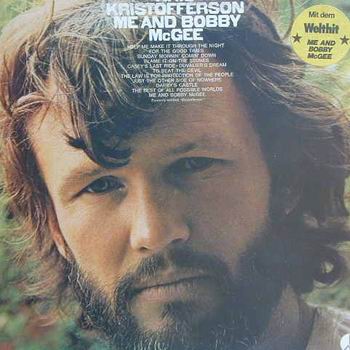
If you've never listened to Kris Kristofferson's music, do so. He is a real anti-pop hero. He is not pretentious, and he has never put his image or act above his talent (e.g. just about every "star" in music history).
The following list is of only 6 recommended Kris Kristofferson songs, along with lyrics (in no particular order).
1. "The Pilgrim Chapter 33" (I get the Pilgrim part--"Searching for a shrine he's never found"--, but I've yet to figure out the Chapter 33 part. Enlighten me, if you can)
See him wasted on the sidewalk in his jacket and his jeans,
Wearing yesterday's misfortunes like a smile
Once he had a future full of money, love, and dreams,
Which he spent like they was going out of style
And he keeps right on a'changing for the better or the worse,
Searching for a shrine he's never found
Never knowing if believing is a blessing or a curse,
Or if the going up was worth the comin' down
He's a poet, he's a picker
He's a prophet, he's a pusher
He's a pilgrim and a preacher, and a problem when he's stoned
He's a walking contradiction, partly truth and partly fiction,
Taking every wrong direction on his lonely way back home.
He has tasted good and evil in your bedrooms and your bars,
And he's traded in tomorrow for today
Running from his devils, Lord, and reaching for the stars,
And losing all he's loved along the way
But this world keeps right on turning for the better or the worse,
And all he ever gets is older and around
From the rocking of the cradle to the rolling of the hearse,
The going up was worth the coming down
He's a poet, he's a picker
He's a prophet, he's a pusher
He's a pilgrim and a preacher, and a problem when he's stoned
He's a walking contradiction, partly truth and partly fiction,
Taking every wrong direction on his lonely way back home.
There's a lotta wrong directions on that lonely way back home.
2. "Sunday Morning Coming Down" (For many, this is an anthem. For others, it's a reason to be thankful)
Well I woke up Sunday morning,
With no way to hold my head that didn't hurt.
And the beer I had for breakfast wasn't bad,
So I had one more for dessert.
Then I fumbled through my closet for my clothes,
And found my cleanest dirty shirt.
And I shaved my face and combed my hair,
And stumbled down the stairs to meet the day.
I'd smoked my brain the night before,
On cigarettes and songs I'd been picking.
But I lit my first and watched a small kid,
Cussin' at a can that he was kicking.
Then I crossed the empty street,
And caught the Sunday smell of someone fryin' chicken.
And it took me back to something,
That I'd lost somehow, somewhere along the way.
On a Sunday morning sidewalk,
Wishing, Lord, that I was stoned.
'Cause there's something in a Sunday,
Makes a body feel alone.
And there's nothin' short of dyin',
Half as lonesome as the sound,
Of the sleeping city sidewalks:
Sunday morning comin' down.
In the park I saw a daddy,
With a laughin' little girl who he was swingin'.
And I stopped beside a Sunday school,
And listened to the song they were singin'.
Then I headed back for home,
And somewhere far away a lonely bell was ringin'.
And it echoed through the canyons,
Like the disappearing dreams of yesterday.
On the Sunday morning sidewalk,
Wishing, Lord, that I was stoned.
'Cos there's something in a Sunday,
Makes a body feel alone.
And there's nothin' short of dyin',
Half as lonesome as the sound,
On the sleepin' city sidewalks:
Sunday mornin' comin' down.
3. Me and Bobbie McGee (you probably know Janis Joplin's awesome version)
Busted flat in Baton Rouge, headin' for the train,
Feelin' nearly faded as my jeans.
Bobby thumbed a diesel down, just before it rained;
Took us all the way to New Orleans.
I took my harpoon out of my dirty red bandanna,
And was blowing sad while Bobby sang the blues.
With them windshield wipers slappin' time,
And Bobby clappin' hands,
We finally sang up every song that driver knew.
Freedom's just another word for nothing' left to lose:
Nothin' ain't worth nothin' but it's free.
Feeling good was easy, Lord, when Bobby sang the blues.
Feeling good was good enough for me;
Good enough for me and Bobby McGee.
From the coal mines of Kentucky to the California sun,
Bobby shared the secrets of my soul.
Standin' right beside me, Lord, through everything I've done,
Every night she kept me from the cold.
Then somewhere near Salinas, Lord, I let her slip away,
Lookin' for the home I hope she'll find.
And I'd trade all my tomorrows for a single yesterday,
Holdin' Bobby's body next to mine.
Freedom's just another word for nothing' left to lose:
Nothin' left is all she left for me.
Feeling good was easy, Lord, when Bobby sang the blues.
Buddy, that was good enough for me;
Good enough for me and Bobby McGee.
4. "From the Bottle to the Bottom" (a typical country song written masterfully by a true Rhodes Scholar--yes, Kristofferson was a Rhodes Scholar)
You ask me if I’m happy now
That’s good as any joke I’ve heard
It seems that since I’ve seen you last
I done forgot the meaning of the words
If happiness is empty rooms
And drinkin’ in the afternoon
Well I suppose I’m happy as a clam
But if it’s got a thing to do
With smilin’ of forgettin’ you
Well I don’t guess that I could say I am
Did you ever see a down and outer waking up alone
Without a blanket on to keep him from the dew
When the water from the weeds has soaked the paper
He’s been puttin’ in his shoes to keep the ground from comin’ through
And his future feels as empty as the pocket in his pants
Because he’s never seen a single dream come true
That’s the way that I’ve been feelin’ since the day I started falling
From the bottle to the bottom stool by stool
Learnin’ hard to live with losin’ you
You wonder if I’m better off
With freedom now to do the things I choose
With all my times my own and
I got nothin’ left but sleepin’ time to lose
There’s no one here to carry on
If I stay out the whole night long
Or give a tankerous damn if I don’t call
I’m livin’ like I wanted to
And doin’ things I wanna do
And nothin’ means a thing to me at all
Did you ever see a down and outer waking up alone
Without a blanket on to keep him from the dew
When the water from the weeds soaked the paper
He’s been puttin’ in his shoes to keep the ground from comin’ through
And his future feels as empty as the pocket in his pants
Because he’s never seen a single dream come true
That’s the way that I’ve been feelin’ since the day I started falling
From the bottle to the bottom stool by stool
Learnin’ hard to live with losin’ you
5. "To Beat the Devil" (If you can't tell by the spoken intro, it's dedicated to Johnny and June Carter Cash)
A couple of years back, I come across a great and wasted friend of mine in the hallway of a recording studio; and while he was reciting some poetry to me that he'd written, I saw that he was about a step away from dyin' and I couldn't help but wonder why. And the lines of this song occurred to me. I'm happy to say he's no longer wasted and he's got him a good woman. And I'd like to dedicate this to John and June, who helped show me how to beat the devil.
It was winter time in Nashville, down on music city row.
And I was lookin' for a place to get myself out of the cold.
To warm the frozen feelin' that was eatin' at my soul.
Keep the chilly wind off my guitar.
My thirsty wanted whisky; my hungry needed beans,
But it'd been of month of paydays since I'd heard that eagle scream.
So with a stomach full of empty and a pocket full of dreams,
I left my pride and stepped inside a bar.
Actually, I guess you'd could call it a Tavern:
Cigarette smoke to the ceiling and sawdust on the floor;
Friendly shadows.
I saw that there was just one old man sittin' at the bar.
And in the mirror I could see him checkin' me and my guitar.
An' he turned and said: "Come up here boy, and show us what you are."
I said: "I'm dry." He bought me a beer.
He nodded at my guitar and said: "It's a tough life, ain't it?"
I just looked at him. He said: "You ain't makin' any money, are you?"
I said: "You've been readin' my mail."
He just smiled and said: "Let me see that guitar.
"I've got something you oughta hear."
Then he laid it on me:
"If you waste your time a-talkin' to the people who don't listen,
"To the things that you are sayin', who do you think's gonna hear.
"And if you should die explainin' how the things that they complain about,
"Are things they could be changin', who do you think's gonna care?"
There were other lonely singers in a world turned deaf and blind,
Who were crucified for what they tried to show.
And their voices have been scattered by the swirling winds of time.
'Cos the truth remains that no-one wants to know.
Well, the old man was a stranger, but I'd heard his song before,
Back when failure had me locked out on the wrong side of the door.
When no-one stood behind me but my shadow on the floor,
And lonesome was more than a state of mind.
You see, the devil haunts a hungry man,
If you don't wanna join him, you got to beat him.
I ain't sayin' I beat the devil, but I drank his beer for nothing.
Then I stole his song.
And you still can hear me singin' to the people who don't listen,
To the things that I am sayin', prayin' someone's gonna hear.
And I guess I'll die explaining how the things that they complain about,
Are things they could be changin', hopin' someone's gonna care.
I was born a lonely singer, and I'm bound to die the same,
But I've got to feed the hunger in my soul.
And if I never have a nickle, I won't ever die ashamed.
'Cos I don't believe that no-one wants to know.
6. "Loving Her Was Easier (Than Anything I'll Ever Do Again)" (This is possibly the most beautifully written love song that I have ever heard. Waylon Jennings covered it, and I'll recommend his version as well)
I have seen the morning burning golden on the mountains in the skies.
Achin' with the feelin' of the freedom of an eagle when she flies.
Turnin' on the world the way she smiled upon my soul as I lay dying.
Healin' as the colours in the sunshine and the shadows of her eyes.
Wakin' in the mornin' to the feelin' of her fingers on my skin.
Wipin' out the traces of the people and the places that I've been.
Teachin' me that yesterday was something that I never thought of trying.
Talkin' of tomorrow and the money, love and time we had to spend.
Lovin' her was easier than anything I'll ever do again.
Comin' close together with a feelin' that I've never known before, in my time.
She ain't ashamed to be a woman, or afraid to be a friend.
I don't know the answer to the easy way she opened every door in my mind.
But dreamin' was as easy as believin' it was never gonna end.
And lovin' her was easier than anything I'll ever do again.
7. "Why Me" (This is perhaps the finest gospel song ever written. It's not full of the typical Christian music arrogance and pretension--e.g. "I'm saved!"--but is written from a more sincere point of view. Read the lyrics and listen to Krstofferson's version if you really want to see what I mean).
Why me, Lord?
What have I ever done
To deserve even one
Of the blessings I've known?
Why me, Lord?
What did I ever do
That was worth love from you
And the kindness you've shown?
Lord, help me Jesus!
I've wasted it so.
Help me Jesus;
I know what I am.
Now that I know
That I've needed you so,
Help me Jesus,
My soul's in your hands.
Try me, Lord.
If you think there's a way.
That I can repay
What I've taken from you.
Maybe, Lord,
I can show someone else
What I've been through myself
On my way back to you.
Lord, help me Jesus.
I've wasted it so.
Help me Jesus;
I know what I am.
Now that I know
That I've needed you so,
Help me Jesus,
My soul's in your hands.
Jesus, my soul's in your hands.
8. "Jesus Was a Capricorn" (A cynical masterpiece)
Jesus was a Capricorn, he ate organic foods.
He believed in love and peace and never wore no shoes.
Long hair, beard and sandals and a funky bunch of friends.
Reckon they'd just nail him up if He come down again.
'Cos everybody's got to have somebody to look down on.
Who they can feel better than at anytime they please.
Someone doin' somethin' dirty, decent folks can frown on.
If you can't find nobody else, then help yourself to me.
Get back, John!
Egg Head's cousin Red Neck's cussin' hippies for their hair.
Others laugh at straights who laugh at freaks who laugh at squares.
Some folks hate the whites who hate the blacks who hate the clan.
Most of us hate anything that we don't understand.
'Cos everybody's got to have somebody to look down on.
Who they can feel better than at anytime they please.
Someone doin' somethin' dirty, decent folks can frown on.
If you can't find nobody else, then help yourself to me.
Help yourself, brother.
Help yourself, Gentlemen.
Help yourself Reverend.
9. "The Taker" (This is good advice for fathers of daughters...)
He's a giver, he'll give her
the kind of attention that she's never known
He's a helper, he'll help her
to open the doors that she can't on her own
He's a lover, he'll love her
in ways that she never has been loved before
And he's a getter, he'll get her
by gettin her into the world she's been hungerin' for
'cause he's a taker, he'll take her
to places and make her fly higher than she's ever dared to
He'll take his time before takin' advantage
takin' her easy and slow
And after he's taken the body and soul
that she gives him, he'll take her for granted
Then he'll take off and leave her
takin' all of her pride as he goes
He's a charmer, and he'll charm her
with money and manners that I never learned
He's a leader, and he'll lead her
across pretty bridges he's planning to burn
He's a talker, he'll talk her
right off of her feet, but he won't talk for long
Cause he's a doer, and he'll do her
the way that I never
And damned if he won't do her wrong
'cause he's a taker, he'll take her
to places and make her fly higher than she's ever dared to
He'll take his time before takin' advantage
takin' her easy and slow
And after he's taken the body and soul
that she gives him, he'll take her for granted
Then he'll take off and leave her
takin' all of her pride as he goes
Yes, he's a taker, he'll take her
to places and make her fly higher than she's ever dared to
He'll take his time before takin' advantage
takin' her easy and slow
And after he's taken the body and soul
that she gives him, he'll take her for granted
Then he'll take off and leave her
takin' all of her pride as he goes
10. "If You Don't Like Hank Williams" (This is what I'd like to play for those who can't appreciate music that's not on the current top 40. There's nothing special about the lyrics. It's just the sentiment.)
I dig Bobby Dylan and I dig Johnny Cash
And I think Waylon Jennings is a table thumpin' smash
And hearin' Joni Mitchell feels as good as smokin' grass
And if you don't like Hank Williams, honey, you can kiss my ass
Chorus:
'Cause I think what they've done is well worth doin'
And they're doin' it the best way that they can
You're the only one that you are screwin'
When you put down what you don't understand
I said, I dig Roger Miller, Merle Haggard; George Jones
Shotgun Willie Nelson and them rockin' Rollin' Stones
And Jerry Lee's still gotta be the coolest in the class
And if you don't like Hank Williams, honey, you can kiss my ass.
Chorus:
'Cause I think what they've done is well worth doin'
And they're doin' it the best way that they can
You're the only one that you are screwin'
When you put down what you don't understand
Friday, August 25, 2006
What I Hate Awards
I've been posting this blog for several months now. Although it hasn't even been six months, I'm ready to announce the candidates for the mid-year "Good Response" awards.
While this award involves no money or prize, other than the honor of having made consistently good responses for the past six months, it is the premier award for this blog.
The candidates are:
Golf Guy
Science Guy
Surrealist
Please respond to this post with your vote! Votes will be tallied whenever I feel like it, and they will be posted once I remember to do so.
If you would like to be recognized next Spring at the annual What I Hate Awards, please begin commenting regularly and intelligently.
Fantasy Football 1-2006 Roster
I've completed one of my fantasy football drafts. This one was the keeper league. I kept six players (noted by an asterisk). The rest I just drafted. We start one QB, two RB's, three WR's, one TE, one K, and one D/ST. I think I'm in pretty good shape!
QB's:
Payton Manning *
John Kitna
RB's:
Larry Johnson *
Rudy Johnson*
Reuben Droughns
WR's:
Steve Smith*
Plaxico Burress
Randy Moss
Reggie Brown
Keenan McCardell
TE's:
Tony Gonzales*
Jermaine Wiggens
K's:
Lawrence Tynes
Jason Hanson
D/ST:
Chicago Bears*
Philadelphia Eagles
On waivers--but not yet on my roster--are Priest Holmes (RB) and Bobby Engram (WR)
Subscribe to:
Posts (Atom)